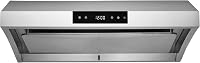
What CFM Should a Range Hood Have?
A range hood needs about 100 CFM for every 10,000 Btu of burner output, so a standard four-burner gas range calls for roughly 300 to 400 CFM. Go higher only when your cooktop needs it and your ducting can carry it.
On this page (10 sections)
- What CFM should a range hood have for my stove?
- Why does a hood's width matter as much as its CFM?
- What duct size and run length can your blower actually support?
- Is 400 CFM enough for a range hood?
- When should you choose more than 400 CFM?
- How do CFM ratings compare at the hood's real working speed?
- What does the 100 CFM per 10,000 Btu rule leave out?
- How does makeup air change the CFM you should buy?
- Which hoods fit each CFM band?
- How do you turn CFM into a shopping decision?
A range hood needs about 100 CFM for every 10,000 Btu of burner output, so a typical four-burner gas range calls for roughly 300 to 400 CFM. That figure is the starting point, not the final answer.
Duct size, hood width and your cooking style all decide what cfm should a range hood have for your own kitchen.
Too little airflow leaves smoke and grease hanging over the stove. Too much airflow wastes money on a blower you can only run at low speed, or it pulls air through a duct that cannot carry the volume.
The right number sits between those two outcomes.
This guide walks through the airflow math, the duct limits, the capture width and the noise trade-off. Each section ends with a rule you can apply to a real shopping decision.
What CFM should a range hood have for my stove?
Start with 100 CFM per 10,000 Btu of total burner output, which is the long-standing sizing rule in the ventilation industry. A four-burner gas range with 9,000 Btu burners totals 36,000 Btu and calls for about 360 CFM.
A 30-inch gas range with higher-output burners lands closer to 400 to 500 CFM.
The rule assumes typical home cooking with moderate smoke. It does not account for a hood that sits too far from the cooktop or ducting that strangles the blower.
Treat the number as a floor for your shopping list, then adjust upward for heavy frying or a high-output wok burner.
Electric cooktops change the math because the Btu figure does not exist. For those, size by cooktop width and cooking volume instead.
A 30-inch electric range in a normal home kitchen works well with 300 to 400 CFM. A 36-inch range or an open-plan kitchen needs more.
The rough airflow math matters most when you plan a remodel. If you already own the range, check its burner Btu labels or the manual to total the output.
That single figure keeps you from buying a blower that is either undersized or larger than your duct can support.
Rule: add up your burners' Btu, divide by 100, and use that as your CFM minimum before you look at any model.
If you want a fuller walkthrough of the sizing math for different cooktop types, our guide to how many CFM range hood do I need breaks it down by stove size.
Why does a hood's width matter as much as its CFM?
Hood width decides how much smoke reaches the blower in the first place. A hood that is narrower than the cooktop leaves the outer burners uncovered, so smoke from those burners can curl past the edges and into the room.
The usual starting rule is to match the hood to the cooktop width. A 30-inch range takes a 30-inch hood, and a 36-inch range takes a 36-inch hood.
A hood 2 to 6 inches wider than the range captures a little more spill at the edges. Our guide to how deep should a range hood be covers the front-to-back dimension, which works the same way.
A wide hood at moderate speed captures more smoke than a narrow hood running at full power. The extra width gives rising smoke a larger target before it escapes.
That means you can sometimes choose a lower CFM rating and a wider hood rather than pushing a small hood harder.
Depth and mounting height also affect capture. A hood mounted too high above the cooktop loses smoke before the blower pulls it in.
The standard mounting window for most residential hoods is 24 to 30 inches above the cooking surface for electric and 27 to 30 inches for gas. A closer mounting height improves capture without raising the CFM.
Rule: never buy a hood narrower than your cooktop, and prefer one a few inches wider when the cabinet layout allows it.
What duct size and run length can your blower actually support?
A CFM rating is only real when the duct behind it is sized for that airflow. A 400 CFM hood on a long, narrow, bendy duct will not move 400 CFM in your kitchen.
The duct becomes the bottleneck, and the blower runs louder as it strains.
The common rough guide is 6-inch round duct for 400 CFM and below, and 7- or 8-inch round duct for higher ratings. Rectangular duct works too, but check the equivalent size.
A 3.25 by 10 inch rectangular duct moves far less air than a 6-inch round duct. The Broan-NuTone Glacier here uses that 3.25 by 10 inch opening for its standard install.
Run length and bends matter as much as diameter. Every elbow and every extra foot of duct adds resistance.
Keep the run as short and straight as the kitchen allows. Smooth metal duct beats flexible corrugated hose, which traps air and adds noise.
A 1200 CFM hood needs large, short ducting to deliver its rated airflow. That is why the TAZPI 1200 CFM hood here belongs in a kitchen planned around a big blower, not dropped into a cabinet run with a 6-inch duct behind it.
Rule: choose duct diameter to match the hood's top CFM, then keep the run short and straight so the blower can actually breathe.
Is 400 CFM enough for a range hood?
For most four-burner gas ranges and normal home cooking, yes, 400 CFM is enough. It meets the 100 CFM per 10,000 Btu rule for a 40,000 Btu range.
It also covers most electric ranges in a standard kitchen.
It falls short in specific cases. High-output burners used often, a wok burner, or a cooktop that totals more than 40,000 Btu push past what 400 CFM handles well.
A hood mounted at the top of the allowed height window also captures less smoke, so a little more airflow helps.
Open-plan kitchens add another wrinkle. Smoke and odors have more room to spread, so the hood has to clear the air faster.
A 400 CFM hood can still work there if it is wide and mounted close to the cooktop.
Our post on is 400 CFM enough for a range hood looks at the borderline cases in more detail. The short version is that 400 CFM suits the majority of home kitchens.
Rule: buy 400 CFM for a standard four-burner range, and step up only when your Btu total or cooking style truly needs more.
When should you choose more than 400 CFM?
Choose a higher rating when your burners total more than 40,000 Btu, you cook smoke-heavy meals often, or you want headroom for a future cooktop upgrade. A 1200 CFM hood is built for wok cooking and open-concept kitchens where heavy smoke is normal.
A gas cooktop with a 15,000 Btu wok burner changes the calculation. One burner alone can produce more smoke than a whole standard range.
The best range hood for gas cooktop options tend to sit in the 500 to 900 CFM range for that reason.
Higher CFM also brings obligations. A big blower needs a big duct, and it needs a makeup air plan.
A hood pulling 1200 CFM can depressurize a house and back-draft other appliances if no air comes in to replace what leaves. Local code often requires a makeup air system above a certain threshold, sometimes around 400 CFM in stricter jurisdictions.
The TAZPI's dual motors and 1200 CFM rating suit a kitchen where heavy frying is routine. Its 55 dB noise rating and gesture controls help when your hands are messy.
That airflow only arrives if the ducting and makeup air are planned for it.
Rule: step above 400 CFM only when your burners or cooking volume justify it and your duct and makeup air plan can carry it.
How do CFM ratings compare at the hood's real working speed?
The rated CFM is the top speed, not the speed you will use most days. Most cooking happens at a middle setting.
The top rating tells you the blower's ceiling, while the noise figure tells you what living with that ceiling costs.
Noise is usually given in sones or decibels. Lower is quieter.
The Broan-NuTone Glacier here is rated at 1.5 sones at its low speed and 5.5 sones at its 375 CFM maximum. That split is normal: the blower gets louder as it moves more air.
A hood rated at 1200 CFM at 55 dB runs quieter at its low setting. The TAZPI description calls out a 400 CFM low mode for that reason.
You get the big ceiling when you need it and a calmer setting for everyday cooking.
This is where a hood with a wide capture area earns its keep. A 30-inch hood at a moderate 300 to 400 CFM handles most meals without pushing into the loud end of its range.
The higher rating is insurance for the heavy-cooking days.
The COSMO Haven's 500 CFM rating sits comfortably above the four-burner minimum. Its four speeds let you find a quieter middle setting for routine meals and push to the top only when smoke builds.
Rule: compare hoods at their everyday middle speed, not just the headline CFM, and pick the quietest model that still meets your Btu minimum.
What does the 100 CFM per 10,000 Btu rule leave out?
The 100-to-1 rule is a solid baseline, but it leaves out capture area, mounting height, duct resistance and your actual cooking. A hood that meets the rule can still underperform if any of those go wrong.
Capture area comes first. A 30-inch hood over a 36-inch range leaves 6 inches of cooktop uncovered.
Rising smoke from the outer burners can escape before the blower sees it. Widening the hood is often cheaper than raising the CFM.
Mounting height comes next. A hood set too high gives smoke time to spread.
Staying within the standard window keeps the blower's job easier and lets a moderate CFM do more work.
Duct resistance is the hidden factor. The same 400 CFM hood performs differently on a short straight 6-inch run than on a long run with several elbows.
A blower working against restriction moves less air and makes more noise.
Cooking style rounds it out. Boiling pasta and simmering sauces produce little smoke.
Sear-steak nights and wok cooking produce a lot. A household that cooks heavy meals several times a week needs more headroom than one that mostly reheats.
Rule: use the Btu rule to set your floor, then adjust for hood width, mounting height, duct run and how often you actually cook smoke-heavy food.
How does makeup air change the CFM you should buy?
Above a certain airflow, a hood needs a plan for the air it pulls out of the house. A blower that moves 1200 CFM removes 1200 CFM of indoor air.
If nothing replaces it, the house goes into negative pressure.
Negative pressure can back-draft a gas water heater or furnace, pulling exhaust gases back into the home. It can also make doors hard to open and pull air through gaps in the building envelope.
That is why building codes increasingly require makeup air for large hoods.
The threshold varies by jurisdiction. Some codes require makeup air for hoods above 400 CFM, others higher.
A 300 to 400 CFM hood usually sits under the common trigger, while a 1200 CFM hood almost always needs a makeup air source.
This is the practical reason to size carefully. Buying a 1200 CFM hood "just in case" adds duct, makeup air and noise costs you may not need.
A 375 to 500 CFM hood covers most gas ranges without those extras.
The Broan-NuTone Glacier's 375 CFM top speed stays close to the common makeup air threshold. Its three speeds and open mesh filters keep the install simple, and its 30-inch width matches a standard range.
Rule: match CFM to your real cooking load, and only take on makeup air when the airflow genuinely calls for it.
Which hoods fit each CFM band?
The right model depends on your burner total and how much smoke you produce, not on the biggest number on the box. These three 30-inch hoods cover a small kitchen, an everyday gas range and a heavy-cooking setup.
Broan-NuTone Glacier: small to medium kitchens
The Glacier suits a standard 30-inch range in a kitchen where moderate cooking is the norm. Its 375 CFM top speed covers a four-burner gas range near the Btu minimum without pushing into large-blower territory.
The three-speed push-button control lets you run low for simmering and high for searing. Its 1.5 sone low setting keeps the everyday noise down.
The dual open mesh filters are dishwasher safe, and the unit installs as ducted or non-ducted.
Choose it for a compact kitchen where the range totals around 36,000 to 40,000 Btu. Skip it if you regularly cook wok-style meals or plan a 36-inch cooktop.
COSMO Haven: everyday gas cooking with more headroom
The Haven suits a 30-inch gas range that needs more than the minimum. Its 500 CFM dual-motor setup gives you airflow headroom for searing and frying without jumping to a 1200 CFM blower.
The four-speed touchscreen control lets you find a middle setting that handles routine meals quietly. Its permanent stainless baffle filters are dishwasher safe.
The included remote adds convenience when your hands are busy.
Choose it for a gas range in the 40,000 to 50,000 Btu range or a household that cooks smoke-heavy meals a few times a week. Skip it if your burners total well over 50,000 Btu.
TAZPI 1200 CFM: heavy smoke and open-plan kitchens
The TAZPI suits a kitchen built around big airflow. Its dual motors rate 1200 CFM, aimed at wok smoke and open-concept layouts where smoke has room to spread.
Its 30-inch width and gesture control help when you are managing a hot pan. The baffle filters are dishwasher safe.
That airflow depends on large, short ducting and a makeup air plan.
Choose it only when your cooktop and ducting are planned for it. Skip it for a standard four-burner range unless you regularly cook at high heat and have the ductwork to match.
How do you turn CFM into a shopping decision?
Use your burner total and your cooking habits to pick a CFM band, then check the duct and noise before you buy. The number on the box matters less than whether your kitchen can support it.
Work in this order. Total your burners' Btu and divide by 100 for the floor.
Widen the hood to match or slightly exceed your cooktop. Check that your duct size carries the top CFM.
Then compare noise at the middle speed you will actually use.
For most homes with a four-burner gas range, that points to a 375 to 500 CFM hood. A 1200 CFM blower is the right call only when your cooking volume and duct plan justify it.
The how many CFM range hood do I need guide covers the stove-by-stove math, and the best range hood for gas cooktop roundup shows which models fit each band.
So what cfm should a range hood have in your kitchen? Start at 100 CFM per 10,000 Btu, add width for capture, and stay within what your duct can carry.
If your burners are standard and your duct is a short 6-inch run, a 375 to 500 CFM hood like the Broan-NuTone Glacier or COSMO Haven covers nearly every meal. Choose the TAZPI 1200 CFM only when heavy smoke and a planned big-duct install make the extra airflow worth living with.
Frequently asked questions
What CFM should a range hood have for a standard 30-inch gas range?
A 30-inch gas range with four burners usually calls for about 300 to 400 CFM. That covers most home cooking without forcing you into oversized ducting.
Check your range's total Btu output first and divide by 100 to get a rough CFM floor.
Does a bigger CFM rating mean better smoke removal?
No. A bigger CFM rating only helps if your ducting can move that much air and your hood's capture area is wide enough.
A wide hood running at moderate speed often captures more smoke than a narrow hood running flat out.
Can I install a 1200 CFM hood in a regular kitchen?
Only when your ducting and makeup air plan support it. A 1200 CFM hood needs short, large-duct runs to work as rated, and many homes need a makeup air source to replace the air the hood pulls out.
Check local code before installing one.
What duct size do I need for a 400 CFM range hood?
Plan on a 6-inch round duct as the usual minimum for a 400 CFM hood. Use smooth metal duct rather than flexible hose and keep the run short with as few bends as possible.
Undersized duct restricts airflow and adds noise.