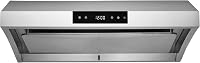
How Many CFM Range Hood Do I Need?
Choose range hood CFM based on your cooktop and duct setup. A common starting point is 100 CFM per 10,000 BTU for a gas range; electric ranges need a different approach, and long or restricted ducts can reduce airflow.
On this page (8 sections)
- How many CFM do I need for a gas range?
- What CFM do I need for an electric cooktop?
- How do duct size and duct length change airflow?
- Is 400 CFM enough for a range hood?
- Does a wider hood need more CFM?
- How much CFM is useful for everyday cooking?
- What should I compare besides the CFM number?
- How do I choose the right range hood CFM?
Choose range hood CFM based on your cooktop's heat output, cooking habits, and duct setup. For a gas range, a common starting point is 100 CFM for every 10,000 BTU of total burner input, but check local requirements and the hood instructions.
For an electric cooktop, that gas rule doesn't apply directly. Hood width, capture area, duct size, and the number of turns in the duct all affect how well a hood clears smoke and cooking vapor.
How many CFM do I need for a gas range?
A common starting point is 100 CFM per 10,000 BTU of total burner input. Add the BTU ratings for the range's burners, then divide the total by 10,000 and multiply by 100.
For example, a range with 50,000 BTU of total burner input points to 500 CFM under that rule. This is a planning estimate, not a substitute for local code, the range instructions, or the hood's installation requirements.
Check whether your local rules require make-up air above a certain airflow level. A qualified installer can help confirm what applies to your home and whether the duct route can support the hood.
For a closer look at gas-cooktop needs, see our guide to range hoods for gas cooktops.
What CFM do I need for an electric cooktop?
Electric cooktops don't use the gas BTU rule, so start with the cooktop and hood manufacturers' guidance. Consider the size of the cooking surface, how often you use high heat, and whether you sear, fry, or cook with strong spices.
A larger cooking area or frequent high-heat cooking may call for more capture capacity. A smaller cooktop used for lighter meals may need less, but the hood must still cover the cooking area and suit the duct.
Don't choose solely by the biggest CFM number. A hood that's too wide or deep for the cabinet, or connected to a poor duct route, may not be a good fit.
How do duct size and duct length change airflow?
Duct design can limit the airflow a hood delivers. Long runs, several elbows, a narrow duct, or a restrictive termination can all add resistance.
Check the hood's required duct diameter and allowed vent direction before you buy. Keep the run as short and straight as practical, and use the duct material and fittings permitted by the manufacturer's instructions and local code.
For example, the COSMO COS-5MU30 uses a 5 in round duct, while the COSMO COS-QS75 calls for a 7.5 in round top vent. Those requirements affect which hood can work with an existing route.
If you aren't sure whether the existing duct is large enough, have an installer check it. A higher rated hood won't correct an undersized or poorly routed duct.
Is 400 CFM enough for a range hood?
400 CFM can be enough for some setups, but it isn't a universal target. Compare it with the cooktop's heat output, the hood's capture area, and the duct route.
For a gas range, apply the common BTU starting point, then confirm code and installation requirements. For electric cooking, follow the appliance guidance and account for how you cook.
Our guide to whether 400 CFM is enough for a range hood walks through the tradeoffs in more detail. It can help you decide whether a 400 CFM model suits your burners and duct.
Does a wider hood need more CFM?
A hood should generally cover the cooking surface, and extra width can improve capture. CFM alone doesn't show how well a hood captures cooking plume across the burners.
Compare hood width with cooktop width, then check mounting height and depth. A hood mounted too high or with a shallow capture area may let more smoke escape, even if its airflow rating looks large.
See what size range hood you need for help matching hood dimensions to your stove. Also check the required clearance above the cooktop in how high a range hood should be above the stove.
How much CFM is useful for everyday cooking?
Choose enough airflow for your usual cooking, then use the lowest speed that clears the air. Boiling water may need less fan power than frying or searing.
A hood with multiple speeds gives you options. The COSMO COS-QS75 has four fan speeds and a stated 500 CFM airflow, while the AMZCHEF has three fan speeds and a stated 700 CFM airflow capacity.
A higher setting may also sound louder. Check sound information alongside airflow, and see how range hood noise ratings compare before choosing a model you'll use every day.
What should I compare besides the CFM number?
Compare duct compatibility, hood coverage, fan speeds, and noise information alongside CFM. These details help show whether a hood fits your kitchen and your routine.
The COSMO COS-5MU30 has three speeds, a 5 in round duct, and a stated lowest-speed noise level of 50 dB under optimal conditions with rigid ducting. It's also convertible to ductless with a separate carbon filter kit.
The COMFEE' CVU30W4AST is convertible between exhaust and recirculation modes, with three speeds and a reusable aluminum filter. Its listed airflow capacity is 100 CFM, so compare that figure with your cooktop needs before considering it.
For ductless installation, check what extra filters are needed and how often they need care. A recirculating hood filters and returns air to the room, rather than venting it outdoors.
How do I choose the right range hood CFM?
For anyone asking how many CFM a range hood needs, start with the cooktop guidance and calculate a gas range estimate from total BTU input. Then confirm duct size, route, hood coverage, and any local make-up air rules.
Choose a model whose duct requirements fit your kitchen and whose speeds and sound details make sense for your cooking. If the duct run is long or complex, get an installer to review it before you buy.
For a gas stove, use the BTU estimate as a starting point. For an electric cooktop, follow the appliance guidance and compare capture area and cooking habits; read our gas cooktop range hood guide for the gas-specific factors.
Frequently asked questions
How many CFM do I need for a gas range?
A common starting point is 100 CFM for every 10,000 BTU of total burner input, but local code and the range hood instructions may set other requirements. Add up the burners' BTU ratings, then consider duct length, elbows, and the hood's approved installation options.
Is 400 CFM enough for a range hood?
It can be enough for some kitchens, but the answer depends on the cooktop, hood design, and duct run. A gas range with high total BTU input may call for more airflow under the common sizing rule, while a restrictive duct can lower delivered performance.
Does a higher CFM range hood always work better?
No. Higher rated airflow can help move more cooking air, but the duct size, route, and installation must support it.
A powerful hood can also be loud at higher speeds, so compare sound information and use the lowest setting that clears cooking vapor.
How does duct length affect range hood CFM?
Long ducts, sharp turns, and undersized ducts add resistance that can reduce airflow. Follow the hood manufacturer's duct-size and routing instructions, and ask an installer to assess a difficult run instead of choosing a CFM number in isolation.