How to Determine CFM for a Range Hood
To determine CFM for a range hood, size the hood to your cooktop width, then pick airflow from the heat of your biggest burner and how you cook. Match the hood's rated CFM to that number, then check duct size and noise before buying.
On this page (10 sections)
- How to determine CFM for a range hood in three steps
- Why hood width comes before airflow
- Estimating CFM from burner output
- How cooking style changes the number
- Adjusting CFM for a large kitchen or open plan
- Reading a hood's CFM rating correctly
- The make-up air question, in plain terms
- Noise and airflow: the trade-off you cannot skip
- Which CFM range fits your kitchen?
- Final rule for picking your number
You determine range hood CFM in three steps: size the hood to your cooktop width, estimate airflow from your burners, then adjust for how you cook and how your duct is built. The number you land on is a target, and you compare it with hoods that have a rated CFM at or above it.
Most home cooks on a standard gas range land between 400 and 600 CFM. High-output burners, heavy frying or a large cooktop push that up to 900 CFM or more.
The rest of this guide walks through each step so the figure you pick fits your kitchen, not a generic chart.
How to determine CFM for a range hood in three steps
The short answer: match width first, then heat, then cooking style. Each step narrows the range, and the last step decides the final number.
- Measure your cooktop's width and plan a hood at least as wide.
- Note the BTU output of your biggest burner or the total for all burners.
- Add CFM for heavy cooking, then check the duct path.
You don't need all three numbers to be exact. Use them to pick a range, then choose a hood whose ratings fall inside it.
This is the practical version of the full arithmetic. If you want the longer method with worked examples, see our guide on how to calculate CFM for a range hood.
The result here is the same: a range of acceptable airflow, not a single magic number. Write the numbers down before you shop.
A hood's spec sheet shows one figure, but real airflow depends on the fan speed you use and how clean the path to outside is.
Measure your cooktop before you compare hoods. A hood that is too narrow lets smoke curl around the edges no matter how strong the fan is.
Why hood width comes before airflow
Hood width sets how much of the cooktop's smoke the hood can catch, so it comes first. A hood should be at least as wide as your cooktop, and a few inches wider helps on a strong gas burner.
A 30-inch range pairs with a 30-inch hood in most kitchens. A 36-inch range needs a 36-inch hood.
If your cooktop sits close to a wall or a tall cabinet, the hood's capture area matters even more because smoke has less room to spread into before it rises.
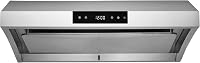
Under-cabinet hoods are common in the 30-inch size, and plenty of choices exist in stainless steel with baffle filters and touch controls. Wider cooktops drive you to 36-inch hoods, which move more air because their opening is larger.
Depth matters alongside width. A deeper hood covers the back burners better than a shallow one, and back burners are where pots sit closest to the wall.
Never choose a hood narrower than the cooktop. If space is tight, look for a deeper hood at the same width instead of a narrower one with more fan power.
Estimating CFM from burner output
A quick rule of thumb: add the BTUs of the burners you actually use and divide by 100. That gives a rough CFM target for the heat on the cooktop.
Here is how it works on common setups:
| Cooktop | Total burner BTUs (typical) | Rough CFM target |
|---|---|---|
| 4-burner gas, standard | 30,000 to 40,000 | 300 to 400 |
| 4-burner gas, high-output | 40,000 to 60,000 | 400 to 600 |
| 5 to 6-burner gas | 60,000 and up | 600 to 900 |
The figures are starting points, not rules. A single 18,000 BTU power burner on the back left matters more than four low-output ones, because that one burner produces a hard column of heat and smoke.
For a full breakdown of matching numbers to burners, read our answer to how many CFM range hood do I need. It covers the BTU method and the width method side by side.
Electric and induction cooktops produce less smoke and less waste heat, so they often work on the lower end of these ranges. Gas cooktops give you more reason to size up, especially with a wok or a griddle pan.
Round up, not down. A hood running a little above your estimate moves smoke faster and lets you turn the fan down for quieter cooking.
How cooking style changes the number
Heavy cooking adds airflow, because fried food, woks and searing send up more grease and smoke. The burner math covers the heat; cooking style covers the load.
If you fry often, sear steaks or stir-fry at high heat, add 100 to 200 CFM to your burner estimate. The extra air pulls the grease-laden smoke out before it settles on cabinets.
The same goes for anyone who boils large pots of stock or uses the back burners constantly.
Light cooking, such as simmering, boiling pasta and reheating, rarely needs more than 400 CFM. A hood with a low quiet setting suits that routine better than a huge fan you only use once a week.
The style of hood matters too. A sealed motor box and baffle filters handle heavy grease better than a basic mesh filter.
Our look at the best range hood for a gas cooktop covers hoods built for this kind of load.
Heavy cooking
Go higher in CFM when you fry or wok regularly. These hoods have the suction and the filters to handle it.
The VIKIO HOME RC13 moves up to 900 CFM and runs a quiet DC motor. Its low speed is rated about 35 dB, so it can handle a stir-fry night without drowning out conversation.
Everyday cooking
A mid-range hood covers most weeknight meals. Look for a fan that has a low setting for boiling and a high setting for the occasional sear.
The Hauslane UC-PS18 spreads its power across 6 speeds and uses baffle filters and a digital touch panel. It is a good fit if you want one hood that handles daily cooking and the odd heavy meal.
Pick 400 to 600 CFM for a mixed routine and 700 to 900 CFM for regular high-heat cooking. Then confirm the hood has at least three fan speeds so you can dial it back.
Adjusting CFM for a large kitchen or open plan
Big open rooms need more airflow, because smoke has more air to mix into before it reaches the hood. Add roughly 100 to 200 CFM when the kitchen opens onto a living area.
The hood's capture depends on how much air sits between the cooktop and the hood's opening. In an open plan, air moves across the room and can push smoke sideways.
A slightly stronger fan compensates, and so does a hood that sits lower over the cooktop.
High ceilings make this worse. A tall ceiling gives smoke room to spread before it gets near the hood, so the fan has to pull from a wider space.
Island cooktops also need more airflow than wall-mounted ones. A hood over an island has no side walls to help guide smoke, so a slightly larger or stronger unit pays off.
Add 100 to 200 CFM for open-plan layouts, and choose a hood with an adjustable speed range so you aren't stuck at full power for a simple meal.
Reading a hood's CFM rating correctly
A CFM number on a box usually describes maximum airflow at the fan, not what you get in your duct run. Real performance depends on the path to outside.
Every bend, long run and narrow duct reduces airflow. A short, straight 6-inch duct gets close to the rated number.
A long run with several elbows can cut it by a third or more. That is why a hood with a higher CFM rating still needs a duct that can carry it.
Hood makers often list a range, such as 300 to 860 CFM for the Hauslane UC-PS18 depending on speed. The top figure needs a matching duct path.
On a narrow 3¼ x 10-inch duct, the hood may move less air than its best number suggests.
Match the duct to the hood's top CFM. A 6-inch round duct is the common minimum for strong hoods, and 8-inch or larger is a better match for 900 CFM and up.
The make-up air question, in plain terms
Make-up air is the fresh air your hood pulls into the house to replace what it sends outside. Without it, a strong hood can starve other appliances of air.
A hood that moves 400 CFM or more in a tightly sealed house can draw air backward down a gas water heater or furnace flue. That is a safety issue, not just a comfort one.
Many local codes require make-up air once a hood crosses a certain CFM, though the threshold varies by area.
If your home is well sealed and your hood is strong, plan for a source of outside air. That can be a dedicated make-up air damper, a slightly open window during heavy cooking, or a hood with a lower maximum that fits your burners.
Hauslane caps the UC-PS18's power control at below 350 CFM through its Power Control Technology. That keeps the hood under the level where make-up air units often become a requirement and saves on install costs.
Check local code before you install a hood over 400 CFM in a tightly built home. A short call to your building department settles it.
Noise and airflow: the trade-off you cannot skip
More airflow usually means more noise. The quietest hood is the one you can run on low for everyday cooking, not the one with the biggest fan.
Sound is usually measured in decibels. A range hood on low can sit around 45 dB, which is a normal conversation level.
At full power, most hoods get noticeably louder.
The airflow rating tells you only the top end. What matters day to day is the low-speed setting and how well the hood handles grease.
Look for baffle filters if you cook with a lot of oil, because they trap grease without clogging.
A dual motor and a well-designed duct path keep noise down at the same airflow, and the VIKIO HOME RC13 uses a DC motor with its own noise reduction. That is the kind of feature to weigh alongside the CFM number.
The COSMO UMC30 Haven sits at 380 CFM with a lowest speed near 45 dB, which suits a smaller kitchen or a cook who wants steady background ventilation. It is not the hood for a 900 CFM sear, but it is a sensible fit for a standard 4-burner range.
Weigh noise at the speed you'll use most. If that is low or medium, a 600 CFM hood with a quiet low setting beats a louder 900 CFM unit you dread switching on.
Which CFM range fits your kitchen?
Use the table as a final check. Pick the row that matches your cooktop and routine, then confirm the hood's width and duct.
| Your setup | Suggested CFM | Notes |
|---|---|---|
| Electric or induction, light cooking | 300 to 400 | Low-speed range matters more than top end |
| Gas, standard 4 burners | 400 to 600 | Round up for frequent frying |
| Gas, high-output or 5-plus burners | 600 to 900 | Confirm 6-inch or larger duct |
| Open plan or island | Add 100 to 200 | Choose a hood with adjustable speeds |
Our take on is 400 CFM enough for range hood goes deeper on the most common cutoff, and the answer depends on your burners and duct more than the number alone.
If your setup lands near 900 CFM, plan the duct and make-up air before you buy. If it lands near 400, a hood like the COSMO UMC30 or the Hauslane on a lower speed covers it.
Write down your target range, then shop for width, duct size and low-speed noise in that order.
Final rule for picking your number
The final rule: size the hood to the cooktop width, pick the middle of your burner-based range, and adjust up for heavy cooking or an open plan. Then confirm the duct can carry the top CFM and that low-speed noise suits your kitchen.
For most gas kitchens, that means a 30-inch or 36-inch hood rated around 500 to 600 CFM with at least three speeds. Heavy cooks and high-output burners push toward 900 CFM with a 6-inch or larger duct.
Light electric cooking sits fine near 400.
Our top pick for a kitchen that needs to cover both daily meals and the occasional sear is the Hauslane UC-PS18, with 6 speeds, baffle filters and 3-way venting to fit your existing ductwork. The VIKIO HOME RC13 is the pick when you need the full 900 CFM, and the COSMO UMC30 Haven fits a smaller gas setup that stays under 400 CFM.
Once you know your number, use our best range hood for gas cooktops guide to compare hoods built to handle it, and revisit how many CFM a range hood needs whenever you change your cooktop or cooking style.
Frequently asked questions
What CFM do I need for a gas range?
A typical 4-burner gas range works with about 400 to 600 CFM, but add more for high-output burners or back burners. Add up the BTUs of your burners and divide by about 100 for a rough starting figure, then round up.
Does a higher CFM hood always vent better?
No. A hood that moves more air than the duct can carry just makes extra noise and can pull air from other rooms.
The duct diameter, length and number of elbows set how much air the hood can move effectively.
Should I size CFM to the hood width or the cooktop width?
Start with the cooktop width so the hood can capture steam and smoke at the edges. Then compare that width with your wall or cabinet space, and finally pick a CFM that matches your burners and cooking style.
What is make-up air, and do I need it?
Make-up air replaces air the hood pulls outside. If your hood moves about 400 CFM or more, a tightly sealed home may need a source of fresh air.
Check local code, since requirements vary by area.