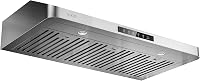
What Size Range Hood for a 48-Inch Range?
For a 48-inch range, choose a hood that is 48 inches wide. That gives edge-to-edge coverage over the cooking surface, and the hood should move at least 100 CFM per 10,000 BTUs of burner output.
On this page (10 sections)
- How wide should a range hood be for a 48-inch range?
- How much airflow does a 48-inch range hood need?
- What hood style works over a 48-inch range?
- What clearance do you need above and around the hood?
- What depth should a 48-inch hood have?
- Which venting setup fits a 48-inch hood?
- How do width and airflow work together?
- What else affects a 48-inch hood install?
- Common mistakes when sizing a hood for a 48-inch range
- The bottom line
For a 48-inch range, choose a hood that is 48 inches wide. That width matches the range edge to edge and captures smoke and grease before it spreads past the cooking zone.
Anything narrower leaves part of the burners uncovered.
A 48-inch range is a big cooking surface, often six or more burners or a griddle section. The hood has to cover all of it and move enough air to clear the whole area.
This guide covers the width, the airflow math and the fit details that matter most.
How wide should a range hood be for a 48-inch range?
The hood should be at least as wide as the range, so 48 inches for a 48-inch range. Edge-to-edge coverage is the baseline, and a hood 6 inches wider (54 inches) captures a bit more spill if your wall space allows it.
Width is the first thing to get right. A hood that matches the range covers every burner, including the front and rear positions where pans sit.
Capture works best when the hood's edges reach past the cooking zone.
| Range width | Minimum hood width | Wider option |
|---|---|---|
| 30 in | 30 in | 36 in |
| 36 in | 36 in | 42 in |
| 48 in | 48 in | 54 in |
| 60 in | 60 in | 66 in |
Why a 48-inch hood is the minimum for a 48-inch range
A narrower hood leaves a strip of the cooking surface outside the capture area. Smoke rising from the outer burners drifts up beside the canopy rather than into it.
Grease follows the same path and settles on nearby cabinets and walls.
Height matters too. A hood mounted too high loses effectiveness even at full width, because smoke has time to spread before it reaches the fan.
Width and mounting height work together.
A 54-inch hood can help when the range sits against a side wall or when you sear at high heat. Only go wider if the wall and duct plan support it.
Treat 48 inches as the floor, not a suggestion. A 36-inch hood over a 48-inch range is a mismatch that airflow cannot fix.
How much airflow does a 48-inch range hood need?
Plan on at least 100 CFM per 10,000 BTUs of total burner output. Add more for long duct runs or several elbows.
A 48-inch pro-style range with 80,000 BTUs of total output needs at least 800 CFM on that rule alone.
Airflow is the second half of the sizing job. Width decides what the hood can reach; CFM decides how fast it pulls air.
A wide hood with weak airflow still lets smoke linger under the canopy.
To find your number, add up the BTUs of every burner on the range. Divide by 10,000 and multiply by 100.
That gives the baseline CFM. A range rated at 100,000 BTUs lands at 1,000 CFM before any duct adjustments.
The 100 CFM per 10,000 BTU rule in practice
The rule assumes a straight, short duct run. Long runs and tight turns cut the airflow that actually reaches the hood.
Here is how the math works for common 48-inch range outputs.
- 60,000 BTUs total: at least 600 CFM.
- 80,000 BTUs total: at least 800 CFM.
- 100,000 BTUs total: at least 1,000 CFM.
- 120,000 BTUs total: at least 1,200 CFM.
Many 48-inch pro ranges fall in the 80,000 to 120,000 BTU band, which puts most setups at 800 to 1,200 CFM. Check your range's rating plate or spec sheet for the exact total.
A hood rated at 1,200 CFM cannot deliver 1,200 CFM through a long, narrow duct. Every foot of run and every elbow costs airflow.
A 48-inch hood with high CFM needs a duct sized for it, often 8 to 10 inches round or an equivalent rectangular duct.
Size up on rated CFM when the run is long or has several turns. A hood with headroom runs quieter at a lower speed and still clears the range.
Our guide to range hood airflow and noise explains how to match the two.
Pick the hood's CFM for the range's BTU total, then add headroom for the duct. A hood that only meets the baseline in a perfect install will struggle in a real one.
What hood style works over a 48-inch range?
A wall-mount canopy or an under-cabinet hood both work, and the choice depends on your wall space and cabinet layout. A 48-inch range needs a hood that carries its width without sagging or blocking sightlines.
A wall-mount canopy hangs from the wall above the range and suits a range against an open wall. An under-cabinet hood attaches to the bottom of the upper cabinets and needs cabinets wide enough to span 48 inches.
Which style fits your kitchen
A wall-mount canopy is the usual choice over a 48-inch pro range. The canopy often extends 24 to 27 inches deep for wide front-to-back coverage.
Many pro-style canopies pair with a separate blower so you can match CFM to the range. They need a clear wall, solid framing and a vent path through the wall or roof.
An under-cabinet hood tucks beneath the upper cabinets and saves overhead space. It needs a cabinet run at least 48 inches wide and enough depth for the hood body.
Under-cabinet hoods over a 48-inch range often top out at lower CFM than large canopies. Check depth against cabinet depth, and keep the same clearance above the cooktop.
If you are comparing vented and recirculating setups, read our guide to convertible vs ducted range hood before you commit to a style.
What clearance do you need above and around the hood?
Plan on 24 to 30 inches between the cooking surface and the hood's bottom edge. The hood's installation guide gives the exact figure.
A 48-inch pro range often wants the upper end, closer to 30 inches.
Clearance affects both safety and capture. Too low, and the hood gets in the way of tall pots.
Too high, and smoke spreads before the fan can grab it. The right number sits in the maker's stated range for your model.
Keep the hood's edges clear of combustible cabinets and walls. A wide canopy over a 48-inch range often reaches close to side cabinets.
Check the maker's required clearance to combustible materials on each side.
The vent connection needs room as well. A duct that turns sharply right at the hood outlet restricts airflow.
Leave space above or behind the hood for a smooth transition into the duct.
A hood at the high end of the range needs more CFM to compensate. If the only option is a tall mounting height, size up on airflow.
Set the height from the maker's guide, then match CFM to that height and your burner total. A wide hood mounted too high underperforms a narrower one set at the right height.
What depth should a 48-inch hood have?
Aim for a hood depth that covers most of the range's front-to-back surface, often 24 to 27 inches for a pro-style canopy. Depth matters as much as width, because smoke rises from the front burners as well as the rear.
A shallow hood leaves the front of the range exposed. When you sear or stir-fry at a front burner, smoke rises in front of a shallow canopy and drifts into the room.
A deeper canopy reaches over the whole cooking zone.
| Hood depth | Coverage note |
|---|---|
| 18 in | Covers the rear of the range; front burners sit partly outside |
| 24 in | Covers most of the range depth for many setups |
| 27 in | Reaches over the front burners on a deep pro range |
Matching depth to your cooktop
Measure the range's cooking surface from front edge to back edge. The hood's depth should cover as much of that surface as possible.
A 48-inch range with a deep cooktop needs a matching canopy depth.
Check that the canopy does not block the view of the back burners or the oven controls. A shallow under-cabinet hood can still work when most cooking happens at the rear, as long as width and CFM are right.
Depth is the spec people skip, and it shows in everyday cooking.
Measure the cooktop depth before you buy. A 48-inch-wide hood with a shallow canopy is only a partial solution for a deep pro range.
Which venting setup fits a 48-inch hood?
Vent outside when you can. A ducted hood pushes smoke and grease outdoors, which matters more over a high-BTU 48-inch range than over a small cooktop.
Recirculating hoods filter the air and send it back into the room.
A 48-inch range produces a lot of smoke and grease at high heat. An outside vent removes it completely.
A recirculating setup traps some grease and odors but leaves moisture and fine particles in the kitchen.
For high CFM, plan a short, straight run with few elbows. The duct diameter should match the hood's outlet and its CFM rating.
A 48-inch hood rated at 1,000 CFM or more often needs an 8-inch or larger duct. The roof or wall cap matters too, since a restrictive cap cuts airflow.
Choose one rated for the CFM the hood moves. Our guide to what size range hood you need covers the duct and airflow basics for every range width.
Convertible and ductless hoods over a 48-inch range
A convertible hood can vent outside or recirculate, so you can switch later. A ductless hood filters and recirculates only.
Over a 48-inch range, a ductless hood needs strong filtration and frequent filter cleaning to keep up. Our roundup of the best 36 inch ductless range hood shows what to expect from a ductless design, though a 48-inch setup needs a wider model.
Vent outside for a 48-inch range whenever the wall or roof allows it. If it does not, choose a ductless hood with strong filters and plan on regular cleaning.
How do width and airflow work together?
Width and airflow are a pair. A wide hood captures smoke across the whole range, and enough CFM pulls it up and out.
One without the other leaves a gap in performance.
A 48-inch hood with 400 CFM captures smoke across a wide area but cannot clear it fast enough at high heat. A narrow hood with 1,200 CFM pulls hard but leaves the outer burners exposed.
The right setup covers the full width and moves air at the rate the burners need.
More burners and higher BTUs mean more smoke. A 48-inch range with six burners and a griddle needs more airflow than a four-burner range of the same width.
Add up the BTUs and use the 100 CFM per 10,000 BTU baseline.
Then factor in how you cook. High-heat searing, wok cooking and griddle use produce more smoke than simmering.
If those are regular habits, size up on CFM within the hood's range.
Size up on width when the range sits against a side wall or when smoke tends to escape to one side. Size up on CFM when the duct run is long, when the hood mounts high, or when high-heat cooking is routine.
A 54-inch hood with 1,500 CFM needs a large duct and a lot of wall space, so match each step up to the problem you are solving.
Choose the width for coverage and the CFM for the burners, then adjust one for the room. A balanced setup clears the range without overbuilding the kitchen.
What else affects a 48-inch hood install?
Plan the electrical supply and the mounting structure before the hood arrives. A 48-inch hood is heavy and often draws more power than a small under-cabinet model.
The install needs solid framing and, in many cases, a dedicated circuit.
Check the hood's power requirements against your kitchen's wiring. Pro-style canopies often need their own circuit.
The blower may sit remotely, which changes where the power and duct connect.
A 48-inch canopy can weigh far more than a 30-inch under-cabinet hood, so the wall framing has to carry that weight. Add blocking during the remodel rather than after the cabinets go up.
Two people usually handle a large canopy during installation, and the lift is easier before the range goes in.
Grease filters need regular cleaning, and a 48-inch hood has more filter area to cover. Plan how you will reach the filters and how often you will clean them.
A wide canopy over a high-BTU range collects grease quickly, and recirculating hoods need even more frequent filter attention. Check the filter type before buying so you know the cleaning routine.
Settle the power and mounting plan before you order the hood. The width is the easy part; the install details decide whether the hood works in your kitchen.
Common mistakes when sizing a hood for a 48-inch range
The most common mistake is buying a 36-inch hood for a 48-inch range. The width mismatch leaves the outer burners uncovered.
The second most common is choosing CFM by kitchen size instead of burner output.
Width gets skipped because the range's width feels like the only number that matters. It is the first number, but depth and height decide how much of the cooking surface the hood actually reaches.
A 48-inch hood set too high or too shallow loses capture.
Airflow should follow the range's BTUs and the duct run. A big kitchen does not automatically need more CFM than a small one with the same range.
The burners and the vent path set the number.
A high-CFM hood with a narrow duct cannot deliver its rating, and a wide hood mounted too high misses smoke. Check both before you buy, and size up on CFM if the height or duct run is less than ideal.
Get the width, depth, height and CFM right together. Any one of them off makes the hood work harder than it should for the same result.
The bottom line
For a 48-inch range, buy a 48-inch hood as the minimum width, with a canopy deep enough to reach the front burners. Match airflow to the range's total BTUs at 100 CFM per 10,000 BTUs, and add headroom for a long duct or a high mount.
A 48-inch pro range usually lands in the 800 to 1,200 CFM band.
Pick a wall-mount canopy for a full-width pro range against an open wall. Pick an under-cabinet hood when cabinets span the space and overhead room is tight.
In both cases, vent outside if the wall or roof allows it. If you are still weighing hood widths, our range hood size guide walks through the numbers for every range size.
For a 36-inch setup, see what size range hood for a 36-inch range and compare against your own cooktop.
Frequently asked questions
What size range hood do I need for a 48-inch range?
Choose a 48-inch hood so its capture area spans the full width of the range. A hood wider than 48 inches also works and can capture a bit more spill, but 48 inches is the minimum for edge-to-edge coverage.
Can I put a 36-inch hood over a 48-inch range?
A 36-inch hood leaves 6 inches of cooking surface uncovered on each side. That lets smoke and grease escape around the edges, so a 36-inch hood is a poor fit for a 48-inch range even when airflow is high.
How high should a hood sit above a 48-inch range?
Most makers call for the hood's bottom edge to sit 24 to 30 inches above the cooking surface. Check the hood's own installation guide, because high-BTU pro ranges often want the upper end of that range.
Is a 48-inch range hood too big for a normal kitchen?
A 48-inch hood needs at least 48 inches of clear wall and a vent path that matches its airflow. In a compact kitchen, a 48-inch range is already a large commitment, so confirm the hood's cutout and duct size before ordering.