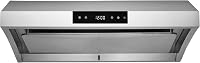
How Much CFM Does a Range Hood Need?
Most gas ranges need 100 CFM per 10,000 BTUs per burner, and most electric ranges need 100 to 200 CFM total. A 30-inch hood over a gas cooktop usually lands around 300 to 600 CFM to clear smoke and grease at the highest setting.
On this page (9 sections)
- How much CFM for range hood do I actually need?
- What does 100 CFM per 10,000 BTUs mean in practice?
- How do duct length and bends change the airflow you need?
- Is 400 CFM enough for a range hood?
- Which CFM fits a 30-inch hood over a gas cooktop?
- Which hoods show how the numbers play out?
- Why do hood width and mounting height matter as much as CFM?
- How do you keep a powerful hood from getting loud or starving the house of air?
- What's the bottom line on range hood CFM?
Most gas ranges need about 100 CFM for every 10,000 BTUs on a burner, and most electric ranges need 100 to 200 CFM total. A typical 30-inch hood over a gas cooktop lands around 300 to 600 CFM, enough to clear smoke and grease at top speed.
Sizing is the whole game. Too little airflow and smoke drifts past the hood; too much and you drain heated or cooled air out of the house for nothing.
How much CFM for range hood do I actually need?
Work it out from the stove, not the kitchen. Add up what your burners put out, divide by 10,000, and you have the minimum CFM for gas cooking.
Electric and induction cooktops need far less because they give off no combustion heat or smoke.
That simple number assumes a normal hood height and a short duct. Most buyers land on a hood between 200 and 600 CFM for home cooking.
Here's the quick rule for the three common setups:
- Electric or induction: 100 to 200 CFM is enough for a 30-inch hood.
- Standard gas: match the burner output, which lands most kitchens between 300 and 500 CFM.
- High-output gas: 600 CFM and up when burners hit 18,000 BTUs or more.
If you want the step-by-step math, our guide to how many cfm range hood do i need walks through burner totals, cooking style and kitchen size.
What does 100 CFM per 10,000 BTUs mean in practice?
It means a 15,000 BTU burner needs about 150 CFM on its own. Follow that ratio and you scale the hood to the flame rather than to the room.
A gas cooktop with four 9,000 BTU burners totals 36,000 BTUs, so the hood needs about 360 CFM.
This rule comes from how much heat and smoke the fuel produces. Gas flames create combustion byproducts and visible smoke that a hood has to pull away.
Big burners change the answer fast. Two 18,000 BTU power burners alone push the total past 500 CFM.
Count only the burners you'd run together at once for a tighter number. Most cooks don't fire every burner at maximum.
Where did the 100 CFM rule come from?
The ratio is a working shortcut, not a code requirement. It ties hood power to the one thing you control at the stove: how much heat the burners release.
Hood makers build to the same idea. VIKIO HOME rates the RC13 at up to 900 CFM and describes it as clearing a 150 sq ft kitchen in 120 seconds, and Broan-NuTone says the Glacier's Captur system removes 97.4% of smoke and odors at 375 CFM.
Both describe the same job: airflow high enough to catch what the burners throw off at full heat.
Use the formula as a floor. If your number lands at 360 CFM, a hood rated a little above it gives you margin for a long duct or a hot pan.
How do duct length and bends change the airflow you need?
Add roughly 1 CFM per foot of duct, then more for every elbow. A long run slows delivered airflow, so the hood has to start with a higher rating to clear the stove.
Each 90-degree turn and each transition costs air. Two bends and a 15-foot run can shave a noticeable slice off rated airflow.
The fix is simple. Pick a hood with CFM above your cooking minimum, or shorten the run with a more direct path to the outside.
A short, straight wall vent is the easiest case. A roof run across the kitchen is the hardest.
Duct shape counts too. The Broan-NuTone Glacier installs through a 3.25 x 10 inch opening mounted vertically or horizontally, or a 7-inch round vertical run with the damper included.
The 7-inch round path carries more air with less friction than the narrow rectangular one, so pick it when the joist space allows.
Our breakdown of how to size range hood cfm covers duct length, transitions and hood height together in one place.
Is 400 CFM enough for a range hood?
For most standard gas cooktops, yes. Four hundred CFM handles a 30-inch hood over an ordinary gas stove and clears smoke from normal frying.
Step up if you sear, grill indoors, or run high-output burners.
Electric and induction owners rarely need that much. A 200 CFM hood can suit a light-use setup.
The catch is duct air and noise. A 400 CFM hood moves real air out of the house, so check local code before going above that figure.
If you're weighing it directly, is 400 cfm enough for range hood tests the number against different burners and cooking styles.
Which CFM fits a 30-inch hood over a gas cooktop?
Match the burner total first, then the hood width. A 30-inch hood over a 30-inch gas range usually needs 300 to 600 CFM, depending on burner power.
A hood narrower than the stove lets smoke escape at the edges, so width and CFM work together.
The pickup area grows with width. A 30-inch hood captures 30 inches of stove edge to edge.
Depth matters on the same principle. The VIKIO HOME RC13 measures 19.75 inches deep and the Broan-NuTone Glacier 19.63 inches, both deep enough to cover the front burners of a standard range.
A shallower body leaves the front edge of the stove uncovered even when the CFM is right.
For gas buyers, our picks of the range hood for gas cooktop put burners, width and duct needs in one place.
Which hoods show how the numbers play out?
The three hoods below cover a light-duty setup, a standard gas kitchen and a heavy-duty gas cooktop. Each one shows what a given CFM figure looks like in a real 30-inch cabinet hood.
Which hood suits a standard gas kitchen?
The Broan-NuTone Glacier fits a typical four-burner gas range. Its Captur system is rated at 375 max blower CFM, which covers a standard gas cooktop under 37,500 BTUs.
It installs as a ducted 3.25 x 10 inch opening vertically or horizontally, a 7-inch round vertical run, or non-ducted with a recirculation filter sold separately. A 7-inch round vertical duct and a clean straight run get the most out of its 375 CFM.
The 3-speed push button control lets you run low for simmering and reach the top speed for searing.
Which hood suits heavy gas cooking?
The VIKIO HOME RC13 sits at the other end. Its dual motors deliver up to 900 CFM, which fits a gas cooktop with power burners, a griddle, or frequent stir-frying.
It runs as low as 35 dB on low speed and stays under 65 dB at full power, so you can talk in an open kitchen while it works. Gesture and touch controls let you adjust speeds with wet or greasy hands, and a memory function restores your last setting.
A 3-minute auto delay shut-off keeps it running after you finish to clear leftover smoke. The 5-layer aluminum mesh filters go in the dishwasher, and the GU10 bulbs are easy to replace.
Check your makeup air rules before you go to this level, because a hood this strong moves a lot of air.
Why do hood width and mounting height matter as much as CFM?
A hood should overhang the cooking surface and sit about 18 to 24 inches above a gas cooktop. Width and height decide how much smoke ever reaches the fan, so they matter as much as the rated airflow.
A hood the same width as the stove catches smoke at the edges. A wider one gives more margin.
Height works against you. A hood mounted higher than the normal range has to pull smoke from farther away, so the same CFM does less.
Balance the three: width for capture, height for reach, CFM for power.
How do you keep a powerful hood from getting loud or starving the house of air?
A higher CFM number often means more noise. Look for a hood that publishes a low sone or decibel figure at working speeds, not just the top rating.
The two scales don't compare directly, but they describe the same thing. Broan-NuTone rates the Glacier at 1.5 sones on low and 5.5 sones at its 375 CFM top speed.
VIKIO HOME quotes the RC13 in decibels, 35 dB low and under 65 dB at full power. Read the rating at the speed you'll actually use.
Duct size matters too. A 7-inch round duct or a wide rectangular one lets a strong hood breathe, while an undersized pipe adds back pressure and noise.
Air balance is the other side. A hood over about 400 CFM can pull air back down a furnace or water heater flue, so local codes often set a makeup air threshold.
Noise reduction and duct size are why a hood can be rated 900 CFM but still feel calm at low speed, like the DC motor in the VIKIO above.
What's the bottom line on range hood CFM?
Add your gas burner BTUs, divide by 10,000, and treat that as the floor; then adjust for duct length and height. Most 30-inch gas kitchens settle at 300 to 600 CFM, while electric and induction setups need only 100 to 200 CFM.
For heavy gas cooking, go toward 600 to 900 CFM and plan the duct and makeup air to match. For a light condo kitchen, a 200 CFM hood like the COMFEE' is the calmer choice.
Start with the burner math, confirm the duct run, then pick the hood that keeps a bit of headroom above your number. That's the whole answer to how much cfm for range hood work in your kitchen.
Frequently asked questions
Is higher CFM always better for a range hood?
No. A higher CFM clears smoke faster, but it also pulls more air out of the house and can be much louder.
A hood sized to your burners does the job without overkill.
Does duct length affect how much CFM I need?
Yes. A long run with bends and elbows means choosing a hood with rated airflow above the cooking range, so the delivered airflow still clears the stove.
Add about 1 CFM per foot of duct as a working guide.
When should I move up to a 600 CFM or 900 CFM hood?
Move up when the stove has high-output burners, a griddle, or a searing burner, or when the hood sits far above the cooktop. High-output setups often need 600 CFM or more.
Do I need a makeup air system for a high-CFM hood?
A hood over about 400 CFM can start pulling air backward down your furnace or water heater flue. Local codes often set a threshold, so check with your installer before going big.