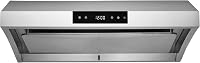
What Size Range Hood for a 36-Inch Gas Cooktop?
For a 36-inch gas cooktop, start with a 36-inch-wide hood. Go up to a 42-inch hood if your cabinet run allows it. Size the airflow to the burner output, roughly 100 CFM per 10,000 BTU, so a typical 36-inch gas top needs about 500 to 650 CFM.
On this page (9 sections)
- How wide should the hood be for a 36-inch gas cooktop?
- How much airflow does a 36-inch gas cooktop need?
- How does venting change the size and airflow you need?
- What mounting type fits under a 36-inch gas cooktop?
- How much clearance do you need above a gas cooktop?
- What else should you check before choosing a 36-inch hood?
- Which hood fits your 36-inch gas cooktop?
- How should you measure before you buy?
- The bottom line on hood size for a 36-inch gas cooktop
The right hood for a 36-inch gas cooktop is a 36-inch-wide hood, with 42 inches as the upgrade if your cabinets leave the space. That matching width catches most of the smoke from edge burners without hanging over empty counter.
Gas changes the airflow math. A 36-inch gas cooktop needs more CFM than an electric top of the same width, because open flames and high heat push more smoke and fumes into the room.
This guide covers width first, then the airflow, venting and mounting details that decide whether a hood actually works over your burners. The products below show what each approach looks like in a real 36-inch cabinet run.
How wide should the hood be for a 36-inch gas cooktop?
Start with a hood as wide as the cooktop: 36 inches. Go up to 42 inches when your cabinet run or wall gives you the room.
A 36-inch gas cooktop usually has four or five burners spread across the full width. The hood's capture area needs to cover those outer burners, not just the middle.
Why matching the width beats guessing
When the hood is narrower than the cooktop, the outer burners sit in open air. Smoke from a searing pan at the edge rises past the hood's rim and spreads into the kitchen.
A hood that is at least as wide as the cooktop pulls that smoke upward before it reaches the sides. Wider than the cooktop gives you a margin for pans that stick out past the edge.
The 36-inch models below all cover a 36-inch cooktop edge to edge. One is notably slim: the FIREGAS FGS-USF39A590AC measures 35.9 inches wide by 17.5 inches deep by 4.7 inches high.
When to choose a 42-inch hood instead
A 42-inch hood catches more smoke at the edges, so it helps with wide pans and a cooktop set close to a wall or corner. The trade-off is space: it needs a wider cabinet run or wall area above the cooktop.
If your cabinets end at 36 inches or a side wall sits close to the cooktop, the matching-width hood is the practical pick.
Rule: match the cooktop width when space is tight, and go one size up when the run allows. If you're still weighing widths, our guide to what size range hood do i need walks through the full range.
How much airflow does a 36-inch gas cooktop need?
Plan on about 100 CFM for every 10,000 BTU of burner output. A typical 36-inch gas cooktop runs roughly 50,000 to 65,000 BTU in total, so the hood should deliver about 500 to 650 CFM on high.
Gas burners make this number higher than for electric. Open flames and high heat send more smoke, steam and combustion byproducts into the air than a flat electric element.
The CFM-to-BTU starting point
The 100 CFM per 10,000 BTU figure is a planning shortcut, not a code. Check your cooktop's BTU rating on its label or in its instructions before you shop.
For a four-burner 36-inch gas top, total output often lands in the 40,000 to 55,000 BTU range. That points to a hood of 400 to 550 CFM on high.
A five- or six-burner top with a high-output burner can reach 60,000 to 70,000 BTU, which calls for 600 to 700 CFM.
Real 36-inch hoods and their CFM
The three hoods in this guide land in different airflow bands. The SNDOAS GF3990S 36 Inch Stainless is rated at 230 CFM on high, a light-cooking figure.
The FIREGAS FGS-USF39A590AC reaches 300 CFM with its two-speed fan. The MOIFELTO DWF06B-90 36 Inch is rated at 700 CFM across three speeds.
Rule: buy the CFM band your burner output calls for. A 300 CFM hood under a 65,000 BTU gas top clears the smoke slowly at best.
For more on matching a fan to a burner, see our range hood for gas cooktop roundup.
How does venting change the size and airflow you need?
Ducted venting sends smoke outside and delivers the hood's rated CFM. Ductless venting recirculates air through a filter and gives up some airflow.
A ducted hood needs a duct route from the cabinet to the outside. Ductless hoods skip the duct, which matters in condos and rentals where cutting a wall isn't an option.
Ducted setups: size the duct to the vent opening
Most under-cabinet hoods in this size use a 7-inch round top vent. Some add a rectangular rear vent, like the SNDOAS model's 9.9 by 3.1 inch rear opening.
Match your duct to the vent size, not smaller.
A short, straight duct run keeps the fan working near its rated airflow. Long runs and sharp bends cut into the CFM the hood can deliver.
The MOIFELTO hood's 700 CFM rating assumes a ducted setup with its exhaust pipe attached.
Ductless setups: plan for the filter and the CFM loss
A ductless hood pulls air through a charcoal filter and blows it back into the kitchen. The carbon filter captures odors and some grease, but the airflow is lower than the same fan running ducted.
The SNDOAS hood comes set up for ductless use with a carbon sponge filter included. It also lists a 7-inch round top vent and a 9.9 by 3.1 inch rear vent for ducted conversion.
You buy the exhaust pipe and the plug kit separately if you convert.
The FIREGAS hood runs ductless only when you add its charcoal filter (FGS-TF39-LW), sold on its own. The MOIFELTO hood also needs a carbon filter for ductless mode.
If your only option is ductless, browse our 36 inch ductless range hood picks before you commit.
What mounting type fits under a 36-inch gas cooktop?
Under-cabinet is the usual choice over a gas cooktop, because most kitchens have cabinets above the stove. It mounts to the cabinet base and hangs below it.
The alternatives are wall-mount and island hoods, which need different cabinet and ceiling setups.
All three hoods in this guide are under-cabinet models. That's the right fit for a cooktop set into a counter with a cabinet run above it.
Under-cabinet: the standard fit
An under-cabinet hood attaches to the bottom of the upper cabinets. Its vent goes through the cabinet above or straight back through the wall.
The FIREGAS hood supports top and rear venting, so the duct can leave in either direction.
Depth matters here. These hoods run about 17.5 inches deep, which lines up with standard 24-inch-deep base cabinets so the front edge sits close to the cooktop's front burners.
The MOIFELTO model measures 18.6 inches deep and 5.1 inches high.
Island and wall setups
A cooktop set into an island needs an island hood, which hangs from the ceiling or a chimney. A cooktop against a wall with no upper cabinet can take a wall-mount hood.
An under-cabinet hood won't fit an island, and an island hood needs ceiling structure a standard cabinet run doesn't have.
Rule: buy the hood type that matches what's above the cooktop. If cabinets are there, stay with under-cabinet.
If the cooktop sits in an island, you need an island hood and a different measurement plan.
How much clearance do you need above a gas cooktop?
Allow at least 24 inches from the cooktop surface to the bottom of the hood. Some gas cooktop makers ask for more, so check the cooktop's instructions.
Heat from a gas burner rises straight up. A hood set too low can overheat and its grease filter can get dangerously hot.
A hood set too high loses smoke to the room before the fan pulls it in.
The height band that works
Twenty-four inches is the floor for most gas cooktops. Going up to about 30 inches is common in kitchens with tall users or high-output burners.
Stay within the range the cooktop maker allows.
The under-cabinet hoods here are slim for a reason. At 4.7 inches high, the FIREGAS and SNDOAS models leave more headroom under the cabinet.
That helps when your cabinet base already sits low.
Check the cabinet base before you buy
Measure from the cooktop surface to the bottom of the upper cabinet. If that gap is under 24 inches, the hood won't fit at a safe height.
You would need to raise the cabinet or choose a different cooktop layout.
Rule: measure the cabinet gap first. If it's 24 inches or more, a slim under-cabinet hood fits.
If it's less, fix the cabinet height before you buy a hood.
What else should you check before choosing a 36-inch hood?
Check the power setup and the filter style next. These details decide how much work installation takes.
The FIREGAS and SNDOAS models are hardwired and don't come with a plug.
The MOIFELTO model comes with a three-prong plug and runs on 120V.
Hardwiring means the hood connects to a circuit through a junction box. If you want to plug it in instead, FIREGAS sells a plug kit (FGS-TF39-DYX) and SNDOAS sells one (PCK-GF3976) separately.
Power, controls and filters
All three hoods use push-button controls, though the MOIFELTO panel has five buttons for its three speeds and two lights. The FIREGAS and SNDOAS models run two speeds.
More speeds give you a gentler low setting for simmering.
All three use aluminum mesh grease filters that go in the dishwasher. The MOIFELTO filters have five aluminum layers plus one stainless layer.
The SNDOAS filter adds a carbon sponge layer for ductless use, which should be replaced every 3 to 6 months. The FIREGAS and MOIFELTO carbon filters are sold separately.
Noise at the top speed
Noise rises with airflow. The FIREGAS hood runs at under 57 dB on high.
The SNDOAS model is rated at 55 dB. The MOIFELTO hood's noise level sits a little under 66 dB, which tracks with its higher 700 CFM output.
If your kitchen opens onto a living area, the quieter hoods are easier to live with.
Dimensions at a glance
| Model | Width | Depth | Height | Max CFM | Speeds |
|---|---|---|---|---|---|
| FIREGAS FGS-USF39A590AC | 35.9 in | 17.5 in | 4.7 in | 300 | 2 |
| SNDOAS GF3990S | 35.9 in | 17.5 in | 4.7 in | 230 | 2 |
| MOIFELTO DWF06B-90 | 36 in | 18.6 in | 5.1 in | 700 | 3 |
Rule: match the power setup and vent type to your kitchen before you buy. A hardwired hood in a rental with no junction box is a problem you can avoid by checking first.
Which hood fits your 36-inch gas cooktop?
The MOIFELTO DWF06B-90 36 Inch is the best pick for most gas cooktops, because its 700 CFM across three speeds handles high-output burners and heavy frying. The FIREGAS FGS-USF39A590AC is the best pick when cabinet headroom is tight.
The SNDOAS GF3990S 36 Inch Stainless is best when ductless is the only option.
Best for high-output gas burners: MOIFELTO DWF06B-90 36 Inch
This is the hood to buy if your 36-inch gas cooktop has a high-output burner or you sear and fry often. At 700 CFM on high, it moves more air than the other two combined.
Three speeds give you a low setting for simmering and a high setting for a screaming pan.
Its 18.6-inch depth reaches farther over the front burners, and its two LED lights cover more of the cooktop. The trade-off is noise: it runs a little under 66 dB at full tilt.
The higher CFM also means it needs a proper ducted setup to deliver its rating.
Best for tight cabinet headroom: FIREGAS FGS-USF39A590AC 36 Inch
Buy this one when the gap between your cooktop and upper cabinet is snug. Its 4.7-inch height leaves more room for the hood while keeping the bottom edge at a safe height.
It covers the full cooktop width at 35.9 inches.
The 300 CFM two-speed fan handles everyday gas cooking and light frying. It's the quietest of the three at under 57 dB on high.
It also runs ductless with a charcoal filter you add separately. The low airflow is the limit: it won't keep up with a high-output burner at full blast.
Best for ductless kitchens: SNDOAS GF3990S 36 Inch Stainless
Choose this hood when you can't vent outside. It ships set up for ductless use with a carbon sponge filter in the box, which saves you the cost of a separate filter.
The 230 CFM two-speed fan suits light cooking, like simmering and low-heat frying. It's rated at 55 dB.
The filter needs replacing every 3 to 6 months. If you cook with high gas heat often, this hood's airflow is the weakest of the three.
Quick comparison
| Model | Best for | Max CFM | Height |
|---|---|---|---|
| MOIFELTO DWF06B-90 | High-output gas burners | 700 | 5.1 in |
| FIREGAS FGS-USF39A590AC | Tight cabinet headroom | 300 | 4.7 in |
| SNDOAS GF3990S | Ductless kitchens | 230 | 4.7 in |
Rule: pick by airflow first, then by fit. A 700 CFM hood over a low-output gas top wastes noise and duct work.
A 230 CFM hood over a 65,000 BTU top leaves smoke in the room.
How should you measure before you buy?
Measure width, depth and height in three places, then measure the vent path and the power source. A hood that misses by an inch won't mount cleanly under the cabinet.
Measure your cooktop's actual width and depth, not the cutout. Gas cooktops vary a little from the nominal size.
The under-cabinet models here run 35.9 to 36 inches wide, which covers a 36-inch cooktop with a small margin.
Height, vent path and power
Measure from the cooktop surface to the bottom of the upper cabinet. You need at least 24 inches.
A slim hood like the 4.7-inch FIREGAS or SNDOAS models fits more low-cabinet kitchens than a taller model.
Trace the duct route from the hood to the outside wall or roof. A short, straight run keeps the fan near its rated CFM.
Confirm the power setup as well. The FIREGAS and SNDOAS hoods are hardwired, and the MOIFELTO hood plugs in.
Rule: measure the cooktop, the cabinet gap, the duct path and the power source before you order. If you're deciding between hood sizes in general, our guide to what size range hood for 36 range covers the stove side of the same question.
The bottom line on hood size for a 36-inch gas cooktop
For a 36-inch gas cooktop, the short answer to what size range hood you need is a 36-inch-wide hood with 500 to 650 CFM, scaled to your burner output. Go to 42 inches when your cabinet run allows it, and raise the CFM if you cook with high-output gas burners.
The MOIFELTO DWF06B-90 36 Inch is the best pick for most gas cooktops, with its 700 CFM and three speeds. Pick the FIREGAS FGS-USF39A590AC when cabinet headroom is tight and 300 CFM suits your cooking.
Pick the SNDOAS GF3990S 36 Inch Stainless when you can't vent outside.
Measure the width, the cabinet gap, the duct path and the power setup before you buy. Those four checks prevent almost every fitting problem.
Frequently asked questions
Does a gas cooktop need more airflow than an electric one?
Yes. Gas burners put out more heat and combustion byproducts than a typical electric top, so the same width hood needs more CFM over gas.
A weak fan over a high-output gas burner leaves smoke and fumes to spread through the kitchen.
Can I put a 30-inch hood over a 36-inch gas cooktop?
No. A 30-inch hood over a 36-inch cooktop leaves the outer burners partly uncovered, so smoke and grease escape around the sides.
Pick a hood at least as wide as the cooktop, and wider if your cabinets allow it.
How much clearance do I need between a gas cooktop and the hood?
Allow at least 24 inches from the cooktop surface to the bottom of the hood. That gap lets the fan pull smoke before it spreads.
Check your cooktop's instructions too, since some makers ask for more, and keep the hood's vent opening clear.
What vent size does a 36-inch hood need?
Many under-cabinet hoods use a 7-inch round top vent, and some add a rectangular rear vent. Match the duct size to the vent opening and keep the run short with few bends.
A duct that is too small or too long cuts the airflow the fan can deliver.