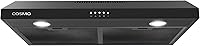
Best Under Cabinet Vent Hoods: How to Choose
The best under cabinet vent hood for most kitchens is a ducted 30 inch model with a 6 in round or 3.25 x 10 in duct and 300 to 400 cfm. It should sit no more than 24 in deep over a standard range, and it should vent outdoors rather than recirculate.
On this page (9 sections)
- Why ducting decides the best under cabinet vent hood
- How much cfm does your range actually need?
- What noise level should you expect in a small kitchen?
- How to match hood depth and height to your cabinet
- Should you choose stainless or a black finish?
- Which filters keep an under cabinet hood working?
- Why the light matters more than the brand
- What a vent hood cannot fix in your kitchen
- Which of these three should you pick?
The best under cabinet vent hood is a ducted 30 inch model with 300 to 400 cfm and a low speed near 1.5 sones. It fits under a standard cabinet, vents outdoors, and clears everyday cooking smoke without roaring.
Every under cabinet hood shares the same constraints: the cabinet sets the width and height, and the duct path decides how much air it can actually move. Get those two right and the rest is noise, light and filter care.
The three hoods below show what a good fit looks like at different airflow levels.
Our picks at a glance
-
1

-
2

-
3

Why ducting decides the best under cabinet vent hood
A ducted hood is the better choice whenever the cabinet sits against an exterior wall or a soffit you can cut. Outdoor exhaust pushes smoke, grease and moisture out of the house, so the kitchen actually clears.
A recirculating hood pulls air through a charcoal filter and blows it back into the room. It removes some odors and catches some grease, but it does not drop the humidity from boiling pasta or clear a seared steak.
That is why ducted wins when a vent is possible.
The duct size matters as much as the hood. A 6 in round duct or a 3.25 x 10 in rectangular duct carries more air than a smaller run, and a long, bendy duct path chokes full airflow even on a strong hood.
The Broan-NuTone Glacier is a good example, because its 4-way convertible design installs as a 3.25 x 10 in ducted opening, a 7 in round vertical run, or non-ducted with a filter sold separately. That flexibility helps if you are working with an existing cabinet cutout.
The 7 in round path is the one people miss. It needs a damper bought separately, so price that in before you commit to the round run.
The boxed hood includes the LED modules, the damper for the rectangular path, the filters and the hardware.
Convertible hoods give you flexibility, and their recirculating mode is only for spots where ducting is truly impossible.
For a deeper look at ducted options, see our roundup of ducted range hoods under cabinet.
How much cfm does your range actually need?
Match airflow to the range, not to the biggest number on a spec sheet. A 30 in gas or electric range is usually fine with 300 to 400 cfm, while a high-output gas burner or frequent wok cooking wants 600 cfm or more.
A simple rule: give the hood about 100 cfm for each 10,000 Btu of burner output. That is a starting point because duct length, turns and the outdoor cap all cut into usable airflow.
Higher cfm is not free. A bigger blower is louder and pulls more air from the room, which can pull conditioned air out of the house and, in a tight home, interfere with combustion appliances.
That last point is why the vent path and make-up air deserve a checkbox.
The Hauslane C100 reaches up to 700 cfm on its top setting, so it suits searing, deep frying and heavier wok cooking. The COSMO UC30 and Broan BCSQ130SS both top out near 375 to 380 cfm, which covers boiling, steaming and everyday frying.
The Broan also carries the Captur blower design, with a forward positioned centric inlet. Broan says that layout removes 97.4% of smoke and odors from the air.
Treat it as a reason to trust the airflow path, not a swap for duct size.
The rated number is also a maximum. On the COSMO, the quietest figure of 45 dB is quoted on the lowest fan speed, with rigid ducting sold separately and under good conditions.
Flexible ducting ships in the box, but a rigid run will do more for real-world performance.
You also need a hood that can exhaust all that air. Undersizing the duct behind a 700 cfm blower wastes it.
If your cooking leans heavy, start with airflow and work back to the duct and cabinet.
What noise level should you expect in a small kitchen?
Look for a low speed near 1.5 sones, because low speed is what you will actually use. The Broan-NuTone Glacier runs at 1.5 sones on its low setting and tops out at 5.5 sones at full blast.
The gap matters. A hood that whispers on low is pleasant for morning coffee and simmering stock; a hood that roars on high is a short burst for frying.
If a hood only has one usable speed, you will reach for the off switch.
Sones double in loudness as the number climbs, so 3 sones is noticeably louder than 1.5, and 6 sones is loud. Look for the low speed figure rather than the headline max.
The Hauslane C100 lists a 6 sone figure, so plan it for the cooking you only do occasionally at full speed. Save the top setting for the pan of bacon, then drop back down.
Comparing sone ratings across the three hoods
Only the Broan lists a full set of sone figures, with 1.5 at the low end and 5.5 at the top. That makes it the easiest of the three to judge on paper.
The Hauslane lists 6 sones, and its product name frames it as a low noise model. The COSMO lists 45 dB instead of sones, quoted at the lowest speed with rigid ducting.
Sones and decibels are not the same scale, so do not line those numbers up side by side as if they were. If quiet matters most, shop by the low setting.
A quieter hood costs less than you would think if you stay ducted and keep the duct short. The trick is buying for the low setting, not the max.
For more on picking a quiet unit, see our guide to quiet under cabinet hoods if your household cooks late or has an open kitchen.
How to match hood depth and height to your cabinet
The cabinet decides two of the three dimensions. Width should match the range, so a 30 in range gets a 30 in hood, and depth should stop around 24 in so the front edge does not hang over the range.
Height is the constraint people forget. The hood body sits directly under the cabinet, and the space between the cooktop and the hood front decides whether you can see into your tallest pot.
| Setup type | Rough fit | Best for |
|---|---|---|
| Shallow built-in hood | Less body height | Tight cabinet-to-cooktop gaps |
Standard 30 in hood | Common under cabinet fit | Most kitchens, everyday cooking
Deeper 30 in hood | More front-to-back body | Wide ranges and larger pans
The COSMO UC30 has a 20.5 in depth and 9.75 in body height, so it takes up more cabinet space than some slim designs. Its stainless body is 430 grade, and it weighs about 25 pounds on the cabinet.
The Broan BCSQ130SS runs 19.63 in deep and 6 in tall, which keeps a cleaner line under a standard cabinet. Its mitered sides and hemmed bottom have no sharp edges, which is a small thing when you reach up to wipe it.
It weighs 18.7 pounds, so one person can hold it in place while the other drives the screws.
The Hauslane C100 is 20 in deep and about 6.25 in tall. It weighs 30 pounds, the heaviest of the three, so plan a second set of hands for the lift.
Measure from the cooktop to the underside of the cabinet before you buy. The hood needs to clear the range's minimum height and still leave working space.
For a full set of width-matched options, our roundup of the best 30 inch under cabinet range hood covers the standard cabinet case.
Should you choose stainless or a black finish?
Stainless is the default because it matches most ranges and hides fingerprints better than gloss. Black is the better choice if your appliances or cabinetry already lean black or dark wood, and it can make a kitchen look more cohesive.
The finish is a small decision compared with the duct and cfm. Still, it changes how the hood reads in the room, because the hood sits at eye level above the cooktop.
Black hoods hide the grease shadow that shows on light finishes, but they show dust and smudges more clearly. Stainless shows nothing at a glance and wipes clean easily.
All three hoods here are stainless steel. If you want a dark finish, look at options in the best black under cabinet range hood roundup.
Pick the finish after you pick the air path. A pretty hood that recirculates still leaves smoke in the room.
Which filters keep an under cabinet hood working?
Baffle and mesh filters both catch grease, but they differ in cleaning. Mesh filters rinse quickly and catch fine particles; baffle filters use curved channels and handle heavy grease better.
The Broan-NuTone Glacier uses dual one-piece dishwasher-safe open mesh filters. Two of them give you a spare while one is in the dishwasher, and the hood works best when the filters are cleaned regularly.
The filter model is HPF30, and Broan recommends changing it about every 6 months, which is the one recurring cost to plan for.
The Hauslane C100 uses a baffle filter and adds a stainless steel grease tray and grease cups. That setup catches the grease that drips off the baffle, so you empty the cup rather than wipe the whole underside.
The boxed parts include one grease tray, two cups and the 6 in round exhaust adapter.
The COSMO UC30 uses ARC-FLOW permanent baffle filters that are dishwasher-safe. You rinse and reuse rather than replace, which keeps running costs low.
Whatever the style, clean the filter before the grease builds and hardens. Most hoods work best with a filter clean every few weeks in a busy kitchen, and a hood with two filters makes that rotation easy.
Why the light matters more than the brand
A bright LED over the cooktop helps you see browning, doneness and spills. A single strong LED is more useful than two dim ones, because you want an even spread across the pan.
The Broan Glacier has one single-intensity LED module controlled from the push button panel. That means one brightness level, so check that it suits you before you buy.
The COSMO UC30 carries 2-watt LEDs in its Haven Collection design. The Hauslane C100 includes LED bulbs for its lighting.
Controls matter too. Push button panels are simple to use with wet hands and easy to find without looking.
The Hauslane C100 lists push button controls, and the COSMO UC30 uses a push button panel as well. The COSMO spec sheet also lists a touch control method, so read the panel description before you assume how the buttons feel.
Look for a hood whose light and fan are separate controls, so you can light the range without running the fan when the kitchen is already cool.
What a vent hood cannot fix in your kitchen
A hood does not replace smooth cooking habits. Grease and smoke build up fastest when oil hits the smoke point, so keep the pan not too hot and use the fan before the pan starts to smoke, not after.
A recirculating hood cannot remove moisture, so if your kitchen windows fog when you boil pasta, a ducted hood is the only real fix. The same goes for smells that linger into the next room.
Finally, do not expect a larger hood to fix a duct that is too small. An undersized duct, a long run or too many turns cuts airflow no matter what the blower rating says.
The Hauslane needs a 6 in round duct to make the most of its 700 cfm, and the COSMO also lists a 6 in round duct size.
Those limits matter for how the hood compares in practice. A well-matched 375 cfm hood ducted properly beats a 700 cfm hood on a skinny duct.
Keep the run short and straight.
If you are reworking a whole cabinet wall, our under cabinet range hood buying guide covers the structural side in more detail.
Which of these three should you pick?
Pick the Broan-NuTone Glacier for most kitchens. It balances a real ducted path, three speeds, a 1.5 sone low setting and an LED at 375 cfm, and its 4-way convertible design handles the odd cabinet cutout.
It is also ADA capable, which matters if someone in the house has trouble reaching controls.
Choose the Hauslane C100 if your cooking is heavier. It reaches 700 cfm and brings a baffle filter with grease tray and cups, so it suits searing and frying.
The 2-year limited warranty and lifetime motor warranty are included with the hood, and the 6 in round adapter is included.
Choose the COSMO UC30 if filter care is your main worry. Its permanent dishwasher-safe filters keep running costs down, and 380 cfm covers everyday cooking.
It comes with a 2-year limited warranty and flexible ducting for a simpler install.
If none of these fits your spot, the best under cabinet vent hood for your cabinet is the one that matches its width, duct and height first. A cheap range hood under cabinet can still clear a small kitchen if it is ducted and sized right.
Measure your cabinet, check the duct, then buy for the low setting. The hood you barely notice is the one you will actually use every day.
Broan-NuTone BCSQ130SS Glacier 30 Inch: Best overall
- 375 max cfm
- 1.5 sones at low
- 30 in wide
- LED light
- 4-way convertible
A 30 in stainless hood with a real ducted path, three speeds and an LED, sized to sit under a standard cabinet over a 30 in range.
Pros
- Three speed control
- LED light included
- Converts to recirculating
Cons
- Filters should be swapped about every 6 months
Hauslane 700 CFM Low Noise 30 Inch: Best for heavier cooking
- 450 to 700 cfm
- 3 speeds
- 6 in round duct
- LED lights
- grease tray and cups
Higher airflow in the same under cabinet footprint, with a baffle filter, a grease container and a 6 in round exhaust adapter.
Pros
- Up to 700 cfm
- Baffle filter
- Grease tray and cups
Cons
- Baffle filter needs a wrench-free soak
- not a quick sponge
COSMO COS-UC30 30 Inch: Best for permanent filters
- 380 cfm
- 3 speeds
- 6 in round duct
- permanent filters
- 2-watt LEDs
A ducted 30 in hood with permanent baffle filters you can rinse and reuse, plus push button controls and a 2-year limited warranty.
Pros
- Dishwasher-safe permanent filters
- 3 speeds
- Push button controls
Cons
- Deeper cabinet body than some 30 in hoods
Frequently asked questions
Can I put an under cabinet hood over a gas range?
Yes, as long as the hood clears the manufacturer's minimum height above the cooktop and the duct run is sized for it. A ducted hood with 300 cfm or more and a real exhaust path handles everyday gas cooking well.
Is a ducted or ductless under cabinet hood better?
Ducted is better whenever you can run a vent outdoors, because it pushes smoke and grease outside rather than back into the room. Ductless suits a spot where a duct is impossible, but it needs a fresh charcoal filter and it will not clear heavy smoke as fast.
How many sones is quiet enough for a small kitchen?
Look for a low speed near 1.5 sones, because that is the setting you will use most for simmering and boiling. A high speed near 5 to 6 sones is normal for the short bursts when you sear or fry.
What width hood fits a 30 inch range?
Match the hood to the range width, so a 30 in range takes a 30 in hood. A wider hood looks oversized under a standard cabinet and a narrower one leaves smoke escaping at the edges.
Do I need a taller cabinet for an under cabinet hood?
The hood body needs a few inches of clearance below the cabinet, so check the height from the cooktop to the cabinet bottom first. If that gap is tight, a shallower hood keeps more working room.